Senator Ben Brown’s Capitol Report for April 29, 2026
Income Tax and Clearing Legislative Hurdles
April is a busy time of year with the state operating budget to finalize and thousands of bills clearing legislative hurdles in route to the governor. Over a dozen have landed on his desk, and six have been inked into law. These laws enact criminal and juvenile justice reforms (Senate Bill 888), allow judges to dissolve a marriage of a pregnant woman (House Bill 1908), and strengthen penalties for sexual offenses, including nonconsensual dissemination of private sexual images (House Bill 2273). To view the entire list, select “truly agreed and finally passed” tab from the legislation section on the Senate website.
Solid Waste Bill Moving in the House
Missouri faces a hidden environmental crisis with 29 abandoned, ownerless landfills leaking waste into our rivers, creeks and watersheds. In District 26, the uncapped Generally Landfill in St. Clair continues to pollute local creeks and threaten the Meramec River, even ruining one family’s dream farm when they discovered toxic seepage on their property. Counties lack the resources for cleanup, and the Missouri Department of Natural Resources (DNR) has been handcuffed by outdated statutes that only grant authority when an owner can be identified—something never envisioned when those laws were written decades ago.
Senate Bill 1586 passed the Senate and is being heard in the House this week. My legislation gives the DNR clear statutory authority to investigate, asses s, test, remediate and manage these orphaned sites. The bill also includes a modest 10% reduction in the solid waste management districts’ share of tipping fees, redirecting those dollars exclusively to cleanup efforts and freeing up millions annually that have been tied up in an inefficient system.
By passing SB 1586, I believe we will deliver real accountability, protect our water for future generations, and begin healing decades of neglect across Missouri.
Professional License Bill Passes Senate
On April 16, the Senate passed my professional licensure reciprocity act, Senate Bill 895. Designed to allow qualified professionals from other states to enter the workforce right away, SB 895 gives candidates with three years’ work experience a pathway to supporting their families while they meet the criteria to obtain a permanent Missouri license. I am optimistic it will maintain this momentum as it proceeds through the Missouri House of Representatives.
Tax Relief for Property Owners
Last week, my legislation addressing unfair and inconsistent reclassifications of short-term rental properties was passed by the Senate. Senate Bill 1066 & 1088 aims to stop the rise of a practice in some counties reclassifying single-family, short-term rental homes as commercial property, essentially taxing them at the commercial rate of 32% instead of the standard 19% residential rate. This practice is not only unfair to property owners, but contradicts Missouri case law, the Federal Tax Code and IRS guidelines, all of which confirm that using a single-family residence for short-term rentals does not justify changing its classification from residential to commercial. Senate Bill 1066 & 1088 will save property owners money and restore fairness statewide by clarifying that single-family homes that are rented for fewer than 30 consecutive days are to be classified as residential, not commercial.
A similar measure progressing as House Bill 1768 & 2060 was passed by the Senate Local Government, Elections and Pensions Committee on April 20. I am optimistic one or both of these bills will head to the governor and deliver relief to affected these property owners.
Enhancing Election Integrity
Senate Bill 896, now on the perfection calendar, prohibits state and local government entities from soliciting, accepting or using private funds or in-kind goods or services for election administration. For the past four years, I have worked to protect Missouri’s elections from outside interference. In 2020, over $400 million in private funding — known as “Zuckerbucks” — flowed through groups like the Center for Tech and Civic Life (CTCL) to election offices nationwide, often with strings attached. Missouri banned direct private donations in 2022, but loopholes remain through membership models, in-kind contributions and indirect funding. This proposal closes these gaps, ensuring no private entity can influence how our elections are run. Elections must be funded and controlled by the public, not outside interests. This bill strengthens voter confidence by keeping Missouri’s election process independent and protected from outside interests
Senate Art Winner from District 26
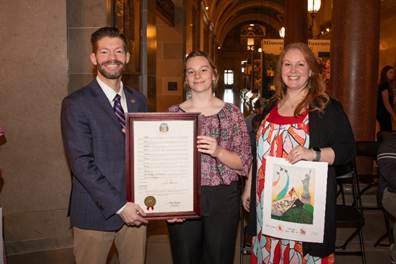
Congratulations to Lexi Manning, the winner of the Senate Art Contest whose artwork titled, “We the People,” will be displayed in the exhibit at the State Capitol. I enjoyed meeting this aspiring artist from Owensville High School and presenting a resolution to her after the awards ceremony in the Rotunda.
Income Tax Elimination in Voters’ Hands
The Missouri Legislature truly agreed to and finally passed House Joint Resolution 173 on April 21. On either the August or November ballot, Voters will now decide whether or not to begin the process to eliminate Missouri’s income tax. Since the bill changed throughout this legislative session, I wanted to provide you with some details on the final version.
Missouri’s individual income tax dates back to 1931, a time when our economy looked nothing like it does today. If approved by voters, this proposal allows the Legislature to modernize our tax code for the 21st Century and beyond by phasing out the state individual income tax and transitioning to a broader, consumption-based system.
How the Plan Works
Income Tax Elimination
The joint resolution requires the General Assembly to establish revenue-based triggers for gradually reducing Missouri’s individual income tax rate. Once those triggers are met and the top rate falls below 1.4%, the state would impose no individual income tax on Missourians. This elimination applies only to individual income and does not apply to corporations, partnerships, trusts, estates or other entities.
Optional Expansion of the Sales and Use Tax
If the legislature wished to expedite the process of eliminating the income tax, they would have the option to broaden the sales tax base within a 5-year window. This expansion is strictly limited: it can only be used for the purpose of reducing or eliminating the individual income tax.
Addressing Common Questions and Concerns
What are the “triggers”?
They would be set by the General Assembly and tied to actual revenue growth. This provides flexibility — if there’s a shortfall, the phase-out slows or pauses. No tax elimination happens unless the state can afford it.
Will this cause the sales tax rate to skyrocket?
In my opinion, no. Claims that the sales tax rate will skyrocket rely on outdated static analysis, which ignores real-world behavioral responses and the bill’s built-in safeguards. Broadening the tax base includes automatic mechanisms to protect taxpayers: any extra revenue generated from newly taxed services or goods must be returned through reductions in the sales tax rate, property tax levies or earnings taxes.
As Missourians keep more of their earnings — the equivalent of a roughly 4.7% raise for many families from reports I’ve seen — consumer spending is expected to rise modestly. This increased volume of taxable transactions will then trigger further rate reductions. In short, the plan is dynamic, not static. It could even open the door to a modest reduction in the sales tax on food, which is currently taxed at 1.225%.
Are there Hancock Amendment protections?
Any expansion of the sales tax base that results in an equivalent reduction in the income tax rate for the purpose of eliminating it entirely is exempt from Hancock limitations during the transition. This ensures the shift can occur smoothly without timeline conflicts between fiscal and calendar years, while still protecting taxpayers. The intent of the Hancock Amendment has always been to prevent any citizen’s tax liability from shooting up without them having a voice at the polls. During this transitional period, those protections granted by Hancock would be preserved through an alternate mechanism. It does this by requiring an equivalent offset in the income tax rate and includes safeguards that ensure any additional tax revenue received by the government is returned to the taxpayer through a reduction in the sales tax rates at the state level and a proportionate reduction in the sales tax, property or real property rates at the local level.
How will this affect seniors and those on fixed incomes?
Any extra revenue from base expansion must be used to lower overall sales tax rates. Many new items in the base (certain digital services, subscriptions) are used more by working-age people. Meanwhile, the effective tax on groceries could decrease. Retirees already flock to no-income-tax states like Florida, which has a higher sales tax than Missouri’s current rate, and thrive there. Businesses will also face downward pressure on prices as their customers have more disposable income, helping keep costs in check.
What about states without income taxes that rely on tourism or oil?
While Florida and Nevada benefit from tourism, and Texas and Alaska from energy resources, states like New Hampshire, South Dakota and Wyoming have thrived without those advantages. Missouri can compete successfully by making our tax code more attractive to workers, families and businesses.
The Kansas Comparison
Critics often cite Kansas as a cautionary tale, but I believe the narrative is misleading. Kansas’s plan was never fully implemented as intended. Promised spending restraint was abandoned, government spending grew significantly, and external factors (oil and agriculture downturns and court-mandated education spending) hit at the same time. Missouri’s proposal is different: it includes strong guardrails, automatic offsets and focuses on both sides of the ledger—revenue and responsible growth.
Why This Is a Better Policy
The income tax punishes productivity—every raise, overtime hour or small business expansion comes with a bigger state bite. It also creates loopholes that benefit those who can afford aggressive tax planning. A broader consumption tax rewards work and investment while taxing spending.
States that have eliminated or minimized income taxes are attracting jobs, people and capital at faster rates. Missouri is falling behind by sticking with a 90-plus-year-old model. This reform gives us a modern tax code built for 2030. It puts more money in Missourians’ pockets and makes our state more competitive.
Voters will ultimately decide. The goal is simple: reduce taxes on work and enterprise, broaden the base fairly and build automatic protections so government doesn’t grow faster than the economy.
It’s an honor representing District 26 in the Missouri Senate. If you have questions about how this might impact your family, your business, or your specific situation, I encourage you to reach out to my office. My team and I are happy to help — feel free to contact us by calling 573-751-3678 or emailing Ben.Brown@senate.mo.gov.