A Costly Tax Shift for Missouri Families On April 16, House Joint Resolution 173 & 174 came before the Senate and passed. I voted no on this measure and remain firmly opposed to it. This proposal – which will go before voters in November – gives lawmakers the authority to raise sales taxes to make up for income tax cuts that I believe would primarily benefit the wealthy. That means taxes could be raised on essentials like groceries, gas, utilities, health care and prescription medications. For working families who are already struggling to keep up with rising costs, this would mean paying more just to get by. Seniors, veterans and Missourians with disabilities would be hit especially hard. Nearly nine out of ten Missourians over the age of 65 live on fixed incomes, and higher sales taxes would significantly raise their cost of living with no way to make up the difference. This plan also goes against the will of the voters, who approved a constitutional amendment in 2016 to prevent new sales taxes. Even more concerning, future sales tax increases under this plan would not require a direct vote of the people. When this measure appears on the ballot, I hope voters will consider what I believe it truly represents: a tax swap that replaces our current income tax with an “everything tax.” I urge you to think carefully about how this change could affect your household budget. This proposal shifts the tax burden onto more working Missourians. Missouri families deserve better, and I strongly encourage you to vote no. Missouri’s FY 2027 Budget Third Read The bills that make up the Missouri operating budget for fiscal year 2027 have been passed by the Senate. I am increasingly uneasy about the direction it sets for our state. Years of questionable fiscal choices have brought us to this point, and the consequences are now evident in the budget before us. After a decade of tax policies significantly reducing state revenues, Missouri is confronting a shortfall that did not arise overnight. This proposed budget is not balanced; it relies on spending more General Revenue than is projected to come in and uses more than $4 billion in one-time surplus funds to bridge the gap for the fiscal year beginning July 1. While this may allow the state to get through the coming year, it raises serious concerns about the stability of Missouri’s finances in the years ahead. I am particularly concerned about what this budget signals about our priorities. Rather than focusing reductions on truly nonessential areas, it cuts $1 million from domestic violence shelters, fails to fully fund public schools, reduces child care assistance and removes $17 million from self-directed services for Missourians with disabilities. These choices have real consequences for families, children and vulnerable Missourians, and they do little to resolve the underlying budget challenges our state continues to face. Senate Bill 838: Protecting Missouri Families from Higher Utility Bills As of April 20, Senate Bill 838, which focuses on limiting the costs energy providers can pass on to consumers, is on the Senate’s informal calendar for third reading. This bill updates Missouri’s energy policy by adding battery storage to the state’s renewable energy standard and creating a zero-emissions credit program tied to electricity produced by nuclear energy. I worked to strengthen this bill with amendments that protect consumers by making sure the costs of nuclear facilities cannot be passed along through higher fees on utility bills and by preventing utility companies from using these projects to increase their profits at the expense of ratepayers. In addition, an amendment proposed by a colleague and approved by the body bans the use of “construction work in progress” charges for nuclear projects. That means utilities cannot charge customers for a plant while it is still being built and not yet providing power. Together, these changes are important wins for Missouri families and are focused on keeping utility bills as affordable as possible. Raising Awareness and Taking Action Against Human Trafficking On April 13, I co-hosted a Human Trafficking Awareness Forum at the Capitol, bringing together lawmakers from both parties to shine a light on this horrific crime. The discussion focused on the reality of human trafficking in Missouri, the laws we have proposed to combat it, and the recent passage of House Bill 2273, an omnibus bill aimed at preventing grooming and trafficking while strengthening protections for children and other vulnerable individuals. We also heard powerful remarks from Pamela Westbrooks-Hodge of Pasadena Hills, a member of the Missouri State Board of Education and president of The Celia Newsom Legacy Foundation. She shared the story of Celia, an enslaved teenager in Callaway County who, after years of sexual abuse, defended herself against her enslaver in 1855. Although Missouri law at the time recognized self-defense against sexual violence, the courts ruled that enslaved women were not entitled to that protection. Celia was convicted and executed later that year. In 2024, after years of advocacy led by Celia’s descendants, Governor Parson granted Celia a posthumous pardon, formally acknowledging the injustice of her conviction. Her story is a painful reminder of why this work matters and why we must continue fighting to protect vulnerable people, confront abuse wherever it exists, and ensure our laws stand firmly on the side of justice. Proud Moments for District 24 Students I want to share a couple of well-deserved student shoutouts from our community. Congratulations to Gabriella Serra, a senior at Pattonville High School, who was selected to represent District 24 in the Senate Student Fine Arts Exhibit through the Missouri Alliance for Arts Education. Gabriella submitted a beautiful needlepoint piece featuring an ocean and mountain scene, and her artwork will be displayed in the Capitol for visitors to enjoy throughout the year. We are incredibly proud of her talent and accomplishment. I also want to extend a big congratulations to Tripp Somerville, a junior at Kirkwood High School, who earned second place in the national C‑SPAN StudentCam Competition. StudentCam challenges students to think critically about issues affecting their communities and our nation. Tripp’s video examines whether the Government Compact for Academic Excellence in Higher Education helps or harms our country’s higher education system. Congratulations, Tripp, and thank you for taking on such an important and thoughtful topic. Stay Up to Date with My Weekly Videos 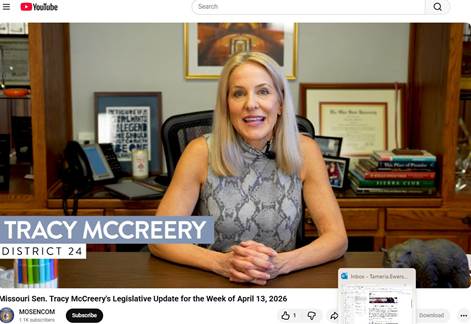
I share a new video almost every week during session with the latest from the Senate. You can watch anytime on the MOSENCOM Senate YouTube channel: https://www.youtube.com/@MOSENCOM. Keep in Touch If there is ever anything I or my amazing staff, Hannah Dolan and Emily O’ Laughlin, can do to assist you, please contact our office at 573-751-9762, email tracy.mccreery@senate.mo.gov or visit us in State Capitol Room 427. To view my sponsored legislation, please visit my official Missouri Senate webpage at senate.mo.gov/McCreery. |